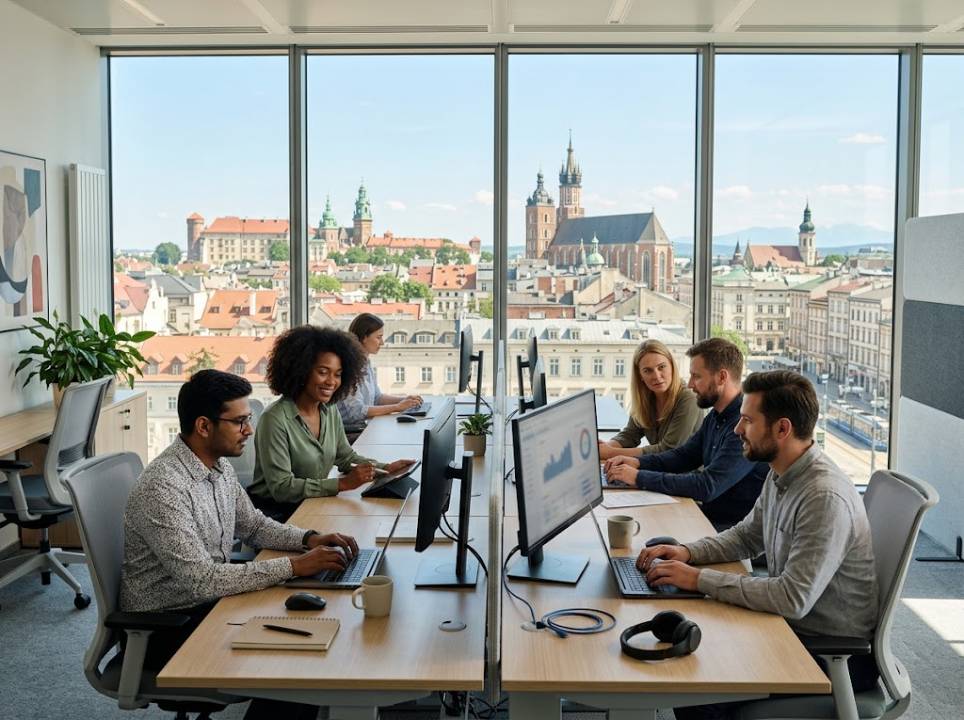
Over the past two decades, Poland has become a major hub for European business. Global companies run shared service centres in Kraków, Wrocław and Warsaw. Manufacturers from Germany, Scandinavia and the United States operate plants across the country. IT firms employ thousands of developers in Polish cities. The reasons are well known: skilled workers, competitive costs, EU membership and proximity to Western European markets.
Less often discussed is the linguistic side of this success. A typical Polish operation works in several languages at once, and managing that mix is part of running it well.
Why nearshoring to Poland works
Nearshoring means moving business processes to a nearby country rather than a distant one. For Western European companies, Poland offers short travel times, similar time zones and a shared regulatory framework. Many Polish professionals speak excellent English, and German is widely spoken in western regions and in industry.
Service centres handle finance, HR, IT support and customer service for markets across Europe, often in a dozen languages from a single office.
A multilingual workplace
Inside a Polish service centre, English is usually the corporate language. Teams serving specific markets work in German, French, Dutch, Italian or Nordic languages. Polish remains the language of local administration, employment law and daily life. Many centres also employ colleagues from Ukraine, Belarus and other neighbouring countries, adding Ukrainian and Russian to the mix.
This diversity is a strength, but it requires clear rules about which language is used for what, and support for colleagues working in their second or third language.
Documentation across languages
Processes, work instructions, training materials and knowledge bases must be available in the languages teams actually use. A finance process designed at a German headquarters may need Polish and English versions for the centre, and customer-facing templates in each market language. Keeping all versions current is a constant challenge.
Choosing the best translation management system for this environment means looking for strong workflow automation, translation memory, integration with knowledge bases and ticketing tools, and clear visibility of which language versions are outdated.
The German connection
Germany is Poland's largest trading partner, and many Polish operations report to German parent companies. Contracts, quality standards, technical documentation and management reports flow between the two countries. Professional german translation services help ensure that nothing is lost between German-language headquarters and Polish or English-speaking teams, particularly for technical and legal content.
Eastern markets and colleagues
Polish operations often serve or source from markets further east, and many employ colleagues from neighbouring countries. Supplier documents, customer correspondence or employee records may arrive in Russian. Accurate russian translation of such documents supports compliance checks, supplier audits and HR processes, especially where sanctions and export controls require careful review.
Employment and compliance
Polish employment law requires certain documents, including employment contracts and workplace regulations, to be available in Polish. Foreign employees may receive bilingual versions. Health and safety training must be understood by every worker, which may mean additional languages on the shop floor. Compliance teams should map which documents need which languages and keep them updated.
Knowledge transfer during setup
When a process moves from Western Europe to a Polish centre, knowledge transfer is critical. Experienced staff train new teams, often through documentation, recorded sessions and job shadowing. Translating key materials, adding glossaries of company terms and providing interpreters for complex training sessions speeds up the transition and reduces errors in the first months.
Customer service in many languages
Many Polish service centres run multilingual customer support for all of Europe. Agents answering German, French or Italian customers must follow the same policies, use the same product terms and offer the same quality. Shared templates, translated knowledge base articles and regular calibration sessions across language teams keep service consistent. When a policy changes, updates must reach every language team on the same day, otherwise customers in different countries receive different answers to the same question.
Practical recommendations
- Define a corporate language and document which languages each team uses.
- Build a multilingual glossary of company and industry terms.
- Centralise translation of processes and knowledge base articles.
- Localise HR and safety documents for every workforce group.
- Support staff working in non-native languages with training and clear writing standards.
Measuring success
Nearshoring projects are usually judged on cost and service levels. Language quality affects both. Errors in customer communication lead to complaints, while unclear internal documentation causes rework. Tracking language-related issues, such as tickets reopened due to misunderstandings, helps managers see where better translation or training would pay off.
Poland as a multilingual success story
Poland's rise as a business location shows what a skilled, multilingual workforce can achieve. Companies that support this workforce with good translation processes, clear documentation and respect for every language in the building get the most out of their Polish operations, and build teams that stay and grow with them.